Zero-Turn Mower Transmissions Explained: EZT vs ZT-2800, ZT-3100, ZT-3400 and ZT-5400
The transmission is one of the most important specs on a zero-turn and one of the easiest to ignore. Here is what actually changes from EZT to commercial Hydro-Gear drives.
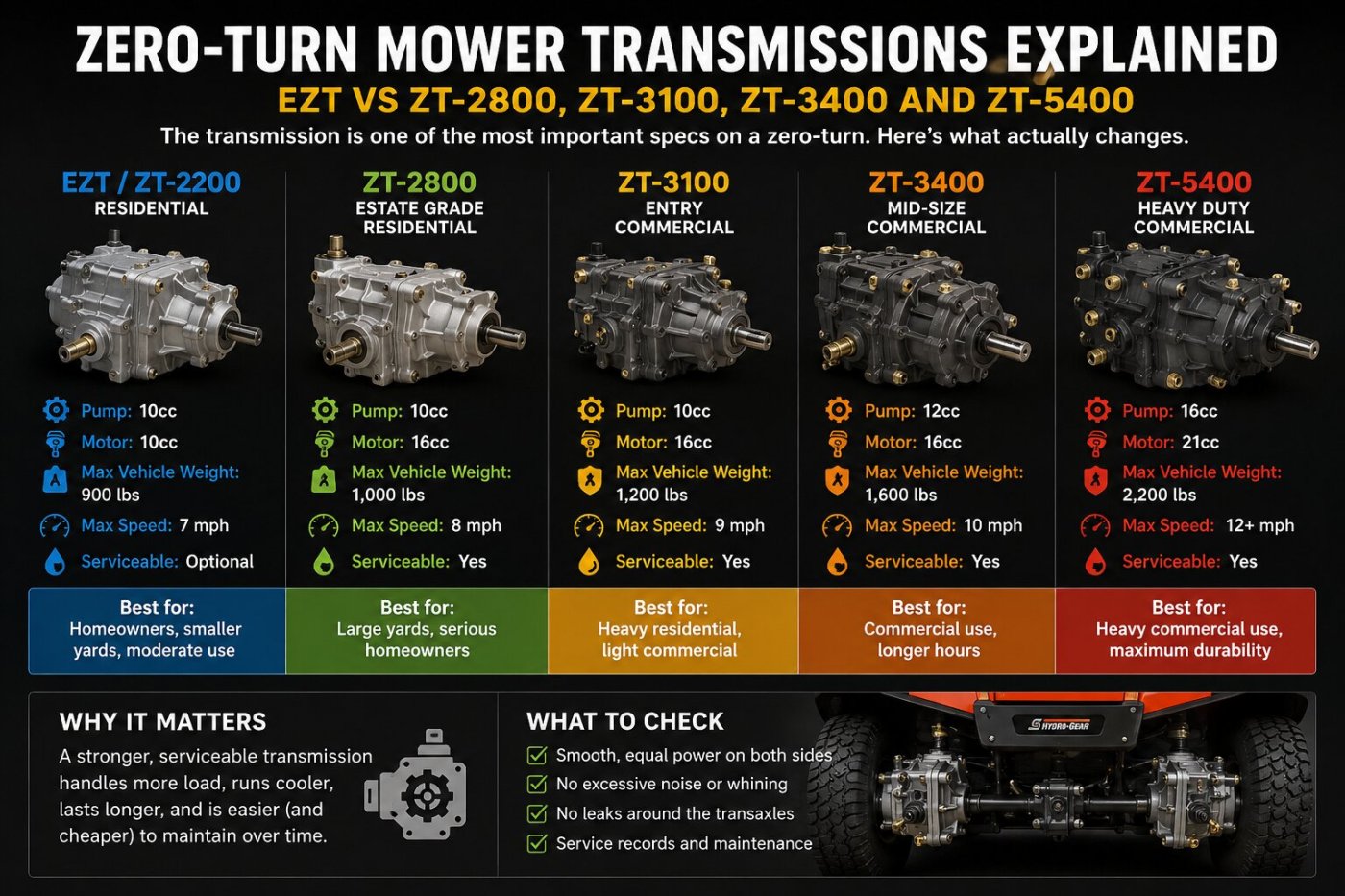
Two zero-turn mowers can have the same 24 HP engine, the same 54-inch deck and almost the same price, yet one can be a much better machine to own for the next ten years.
The difference is often hiding underneath the seat.
The transmission does not get much attention in a showroom. Horsepower is printed on the sign. Deck size is obvious. Suspension is easy to feel. The hydrostatic drive usually gets one line in the specifications, even though it is responsible for moving the mower, steering it and handling the load every minute the engine is running.
That is why we pay close attention to transmission type in our zero-turn reviews.
Hydro-Gear is one of the most common names you will see, with models ranging from the residential EZT to heavy commercial units such as the ZT-5400. The numbers look confusing until you understand what actually changes between them.
Here is the useful version.
The short answer
If you do not want to read the whole guide, this is the basic hierarchy.
- ZT-2200 EZT: Residential. Fine for normal homeowner mowing on relatively flat ground.
- ZT-2800: Heavy residential or estate use. Serviceable and one of the best upgrades for a serious homeowner.
- ZT-3100: Entry commercial grade. A good sign that the mower is built for heavier hours.
- ZT-3400: Proper commercial territory, with more capacity, a larger axle and a stronger hydraulic system.
- ZT-5400: Heavy commercial equipment designed for big machines and long working days.
That does not mean everyone should buy the biggest transmission possible. A ZT-5400 on a one-acre suburban lawn makes about as much sense as buying a dump truck to carry groceries.
The point is to buy enough transmission for the work you actually do.
If you are still figuring out deck size, acreage and terrain first, start with our guide to choosing a zero-turn mower. Transmission should be one part of that decision, not the only part.
What the transmission actually does
A zero-turn does not steer with front wheels like a lawn tractor.
Each rear drive wheel can turn independently. Push both control levers forward and both wheels move forward. Slow one side and the mower turns. Reverse one wheel while driving the other forward and the machine can pivot almost inside its own footprint.
The hydrostatic system is what makes that possible.
On many residential and commercial zero-turns, each side uses an integrated transaxle containing the hydraulic pump, hydraulic motor and gearing in one assembly. The engine turns the pumps, hydraulic pressure drives the motors, and the motors turn the rear wheels.
That is also why transmission condition matters so much.
Every time you accelerate, climb, turn or push a heavy mower through rough ground, the drive system is working. Heat and load matter. A transmission that is perfectly adequate for an hour of residential mowing every Saturday may not be the transmission you want underneath a machine running several hours a day.
Hydro-Gear EZT or ZT-2200
The EZT is also known as the Hydro-Gear ZT-2200, and it is one of the most common residential zero-turn transmissions.
Hydro-Gear rates it as a residential unit. It uses a 10cc pump and 10cc motor, can support vehicle weights up to about 900 pounds and is designed for speeds up to about 7 mph.
That tells you exactly where it belongs.
It is compact, relatively inexpensive and perfectly capable of moving a homeowner mower around a normal lawn. There is nothing automatically wrong with buying one.
The Toro TimeCutter 42 is a good example of the kind of machine where an entry-level hydro makes sense. It is a compact residential mower aimed at smaller properties, not a commercial machine pretending to be one.
Where buyers get into trouble is expecting an EZT-equipped mower to live the same life as a commercial machine.
A homeowner mowing a flat acre once a week creates a very different workload from someone mowing three rough acres, pulling hills and running for hours in summer heat.
There is also an important detail that older buying advice often gets wrong. You will still see the EZT described online as universally sealed and impossible to service. That is too simple now. Hydro-Gear offers current EZT configurations with optional drain ports, but the exact configuration depends on the mower manufacturer.
So do not assume yours can be serviced just because another mower uses the same ZT-2200 family. Check the mower manual and the identification label on the actual transaxle.
Who should buy it: Normal residential users, smaller properties, moderate weekly hours.
Who should look higher: Large acreage owners, rough properties, frequent hill work and anyone planning commercial use.
Hydro-Gear ZT-2800
This is where things get much more interesting for a homeowner who intends to keep a mower for a long time.
Hydro-Gear calls the ZT-2800 its estate-grade residential transaxle. It still uses a 10cc pump, but the motor grows to 16cc. Maximum rated vehicle weight increases to around 1,000 pounds, maximum speed rises to roughly 8 mph, and the unit is designed to be serviced.
That last part matters.
The ZT-2800 has an external oil filter and a serviceable design. You are no longer treating the drive system as something you simply use until there is a problem. It becomes another part of the mower that can be maintained.
The Scag Freedom Z 48 is a good example. It pairs ZT-2800 transaxles with a fabricated deck and commercial-brand construction. That combination makes sense for someone with a couple of acres who wants more durability than a typical entry-level residential machine.
For many serious homeowners, this is the sweet spot.
You are not paying for a huge commercial drive system you will never use, but you are getting a substantial step up from the cheapest residential hardware.
If two otherwise similar mowers are sitting next to each other and one has an EZT while the other has a ZT-2800, I would pay attention to that difference before worrying about whether one engine has two extra horsepower.
Hydro-Gear ZT-3100
The ZT-3100 is where Hydro-Gear starts using the word commercial.
It uses a 10cc pump and 16cc motor like the ZT-2800, but the system is built for more load. Hydro-Gear rates it for vehicle weights up to roughly 1,200 pounds and speeds up to 9 mph. It also gets an external oil filter, and its performance package includes features intended to protect the hydraulic system under harder use.
This is a transmission you often find in high-end residential machines and entry commercial zero-turns.
The Bad Boy ZT Elite 60 is one example. A 60-inch fabricated deck and ZT-3100 drive make far more sense for serious acreage than putting the same wide deck over an entry residential transmission.
There is also a simple ownership argument here.
If you are spending serious money on a mower because you plan to keep it for many years, the transmission deserves part of that budget. A better seat is nice. LED lights are nice. Another inch of deck width is nice.
A stronger, serviceable drive system is something you may still appreciate when the mower has hundreds of hours on it.
Hydro-Gear ZT-3400
Now we are firmly into commercial hardware.
The ZT-3400 moves to a 12cc pump with a 16cc motor, a larger 1.125-inch axle shaft and substantially more capacity. Hydro-Gear rates it for machines up to about 1,600 pounds and speeds up to 10 mph.
This is the type of transmission you start seeing when the rest of the mower is also built for real work.
The John Deere Z730M uses ZT-3400 transmissions even though Deere positions it in a space that can still appeal to serious property owners. That is one reason the machine costs considerably more than an entry Z300.
Another example is the Toro Z Master 2000. Here the ZT-3400 sits under a mower with a heavy commercial deck, tubular frame and suspension seat. Everything is moving in the same direction.
That is what you want to see.
A good mower should make sense as a package. Heavy deck, heavy frame, serious transmission, appropriate engine. One expensive component cannot compensate for everything else being built to a budget.
Hydro-Gear ZT-5400
The ZT-5400 is a different class of equipment.
Hydro-Gear describes it as its largest and most durable integrated unit. It uses a 16cc pump, a motor of about 21cc, a huge 1.375-inch axle and is designed for machines weighing up to roughly 2,200 pounds.
Depending on configuration, it can also support very high transport speeds.
This is not something a normal homeowner needs.
It exists for commercial machines that spend their lives working.
The Gravely Pro-Turn 260 is a good example. It combines a ZT-5400 drive with a commercial 60-inch deck, suspension seat and a machine designed to cover serious acreage.
The Scag Cheetah II 61 takes the idea even further, using a two-speed ZT-5400 setup in a mower built around productivity and speed.
If your mower spends Saturday morning cutting your own lawn, this level is unnecessary.
If the mower earns money Monday through Friday, the calculation changes completely.
Does a bigger transmission automatically mean a better mower?
No.
This is where spec-sheet shopping gets silly.
A mower is a system. The transmission matters, but so do the deck, frame, engine, cooling, seat, tyres, controls, parts availability and dealer support.
Putting a ZT-3100 into a badly built mower does not magically make the whole machine commercial grade.
The opposite is also true. A well-designed residential mower with an EZT can be a much smarter purchase for a one-acre lawn than a heavy commercial machine that costs twice as much, uses more fuel and takes up half the garage.
Buy for the job.
That is the same reason we do not automatically give the highest ZT Score to the mower with the most horsepower or the biggest deck.
Not every good zero-turn uses Hydro-Gear
Hydro-Gear is common, but it is not the only serious drivetrain manufacturer.
Some commercial machines use Parker hydraulic systems. Others use separate hydraulic pumps and wheel motors instead of an integrated transaxle.
That is not a downgrade.
At the top end of the market, the exact system matters less than whether it is correctly sized for the machine, serviceable, supported by the manufacturer and built for the hours you expect to put on it.
So if you find a commercial mower that does not have "ZT-3400" printed in its specifications, do not immediately cross it off your list.
Research the actual drive system.
Serviceability matters, but follow the mower manual
A serviceable transmission is only an advantage if it actually gets serviced.
Oil specifications, filters and service intervals can vary by mower and by the exact Hydro-Gear configuration used by the manufacturer. Do not take a fluid recommendation from a random forum post and assume it applies to your machine.
Use the mower manufacturer's manual first.
Our zero-turn maintenance schedule is a useful framework for the rest of the machine, but the manual should always win when it gives a model-specific interval or fluid specification.
And if you are shopping used, ask for maintenance records.
"Commercial transmission" sounds good in a listing. Proof that somebody actually changed the fluid is better.
How to check a used zero-turn transmission
You do not need to disassemble anything.
Start the mower cold and drive it normally. Both sides should respond smoothly and predictably.
Then keep mowing long enough for the machine to get properly warm. Some hydraulic problems become much easier to notice once the oil heats up.
Pay attention to a few things:
- Does one side feel weaker than the other?
- Does the mower track reasonably straight when both levers are pushed equally?
- Does one drive become noticeably weaker once hot?
- Is there excessive whining under a normal load?
- Can you see hydraulic oil around the transaxle or hoses?
- Does the mower respond cleanly going forward and backward?
- Has the transmission actually been serviced when the manual calls for it?
One strange noise does not automatically mean the hydro is finished. Our zero-turn troubleshooting guide is worth reading before blaming the transmission, because tyre pressure, linkages, belts, bypass levers and brakes can create surprisingly similar symptoms.
Which transmission should you look for?
Forget the idea that there is one correct answer.
For a normal homeowner cutting a relatively flat property once a week, an EZT can do exactly the job it was designed to do.
For a larger property, rougher ground or a buyer who plans to keep the mower for a long time, the ZT-2800 is a very attractive step up.
The ZT-3100 makes sense when the workload starts moving toward heavy residential or light commercial use.
The ZT-3400 belongs in genuinely serious machines.
The ZT-5400 is for commercial work where downtime costs money and the mower itself is carrying far more weight, speed and workload than a residential machine ever will.
Those are shopping guidelines, not acreage limits carved into stone. Terrain, machine weight, mowing frequency and the rest of the mower matter too.
The mistake I would avoid
Do not spend all of your budget on the specifications you can see.
A larger deck looks better on a sales tag. More horsepower sounds better. Fancy lights photograph well. None of those things tell you how the mower will feel after five seasons.
If one machine costs a little more because it steps from an entry residential drive to a serviceable ZT-2800 or ZT-3100, that is a difference worth understanding.
It does not automatically make the more expensive mower the right choice.
But it is a much better reason to spend extra money than buying horsepower your deck does not need.
That is also why our best zero-turns under $4,000 guide looks beyond engine size and cutting width. Value is about the whole machine.
The bottom line
The transmission is not the most exciting part of a zero-turn mower.
It may be one of the most important.
EZT is residential hardware and can be completely appropriate on a normal homeowner machine. ZT-2800 is a meaningful durability and serviceability upgrade. ZT-3100 moves into commercial-grade territory. ZT-3400 is built for heavier professional machines, and ZT-5400 belongs under equipment designed to work for a living.
Match the transmission to the hours and conditions you actually mow.
Then look at the deck, engine, comfort, warranty and dealer support around it.
If you are still narrowing the field, our mower finder can point you toward the right class of machine, or you can browse all zero-turn reviews and compare the transmission alongside the rest of the specifications.