Best Zero-Turn Mowers for Hills and Slopes (2026): What Actually Works
Most zero-turns are not naturally good hill machines. We look at the designs that actually improve traction and control, plus the mowers worth considering for slopes and rolling ground.
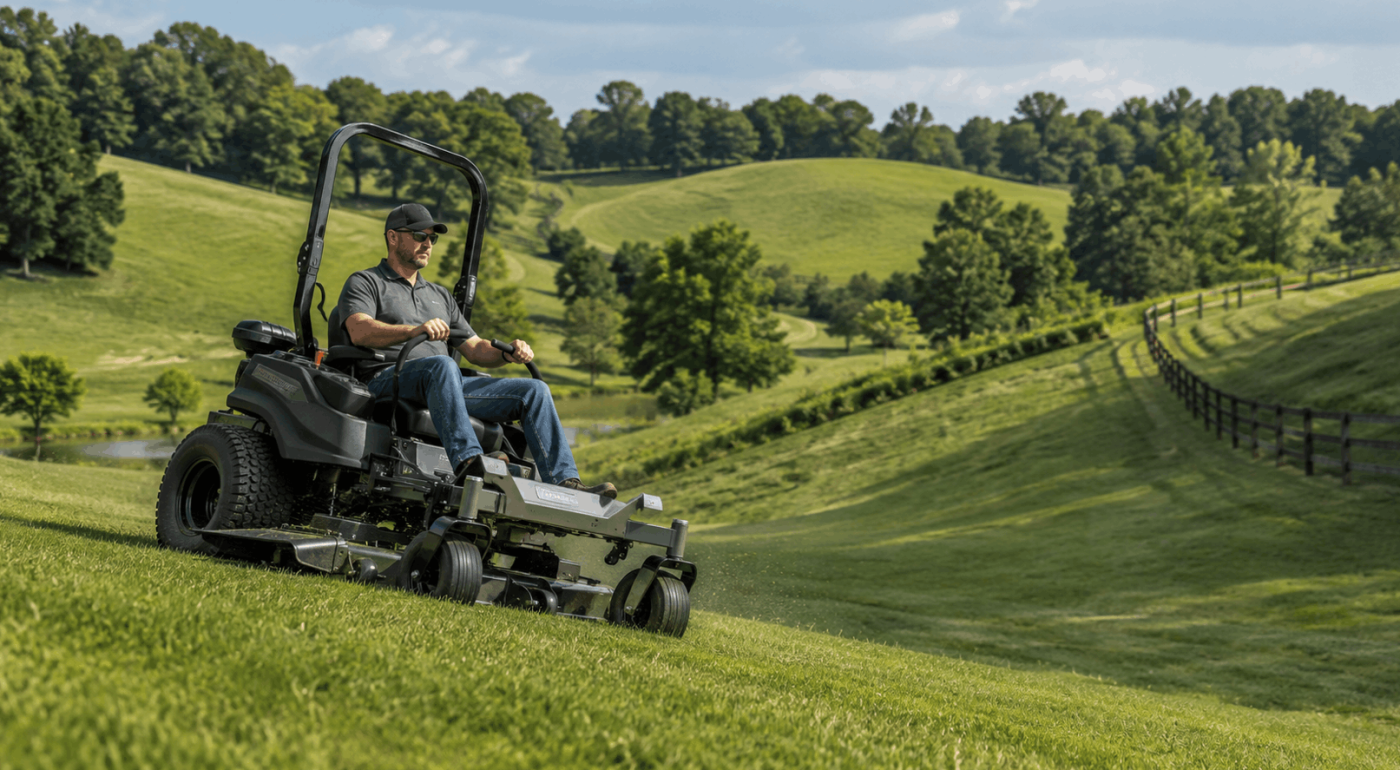
Zero-turn mowers are brilliant on flat ground.
Put the same machine on a steep hill and the story changes quickly.
A normal zero-turn steers with its rear drive wheels. The front casters mostly follow wherever the rear of the mower sends them. That is what gives you the tight turning radius everyone wants around trees and landscaping.
It is also the reason hills can become difficult.
If one rear tyre loses traction, you are not just losing drive. You can lose steering authority at the same time.
That does not mean you cannot use a zero-turn on rolling property. Thousands of owners do. It does mean that buying for hills requires looking beyond horsepower and deck width.
Tyres, centre of gravity, steering design, transmission, machine width and the condition of the ground can matter more than another three horsepower.
And sometimes the correct answer is that a zero-turn is not the right machine at all.
First, how steep is your hill?
This is the question to answer before shopping.
A hill that looks steep from the bottom may only be 8 or 10 degrees. Another section that does not look especially dramatic may be much closer to the operating limit of your mower.
Do not guess.
Use a digital angle gauge, an inclinometer app or a physical slope meter and measure the actual area you intend to mow.
Most conventional zero-turn manufacturers set a maximum around 15 degrees, but your mower's operator manual is the final authority.
Do not assume that because somebody on YouTube crosses a steeper hill, your mower is designed to do the same thing.
Wet grass, loose soil, a hidden rut or one tyre dropping into a depression can change the situation immediately.
If your property has genuinely steep sections, especially around ponds, retaining walls, ditches or drop-offs, a walk-behind mower, slope mower or specialist machine may be the better solution.
Our quick picks
If you already know what kind of property you have, these are the machines from our current catalog that stand out.
Best dedicated zero-turn for hills: Cub Cadet PRO Z 754 S
Best tracked option for difficult terrain: Altoz TRX 354
Best homeowner option for rolling ground: Gravely ZT HD 52
Best compact choice for uneven acreage: Scag Freedom Z 48
Best for rough-ground comfort: Ferris 500S 52
There is an important distinction here.
Only buy a machine for the slope rating specified by its manufacturer. A low centre of gravity or good suspension can make a mower feel better on rolling terrain, but that does not magically increase the safe slope limit in the operator manual.
Best dedicated zero-turn for hills: Cub Cadet PRO Z 754 S
If hills are the reason you are reading this guide, the Cub Cadet PRO Z 754 S is one of the most interesting machines in our entire catalog.
The reason is not its 27 HP Kawasaki engine.
It is the steering.
Instead of conventional lap bars controlling only the rear drive wheels, Cub Cadet uses its Synchro-Steer system. Turning the steering wheel controls the front wheels while coordinating the rear hydrostatic drive.
That matters on a slope.
With a conventional zero-turn, steering depends heavily on traction at the rear tyres. If a rear tyre starts sliding, directional control can disappear surprisingly quickly.
Synchro-Steer gives the front wheels an active role.
Cub Cadet rates the PRO Z 754 S for slopes up to 20 degrees, which is unusual in a category where 15 degrees is a common limit.
The rest of the mower is serious commercial hardware too.
You get a 54-inch triple 7-gauge fabricated deck, a Kawasaki FX850V engine and Hydro-Gear 4400 drive system. This is not a homeowner mower with a steering wheel added to make it look different.
The downside is equally obvious.
It costs commercial money.
If your property is basically flat with one gentle bank, spending this much simply to get Synchro-Steer would be difficult to justify.
But if your acreage contains significant slopes and you still want the speed and manoeuvrability of a zero-turn, this is one of the first machines I would investigate.
Best for: Large properties with real slopes where a conventional lap-bar zero-turn is not ideal.
Skip it if: Your ground is mostly flat and you are paying thousands extra for capability you will rarely use.
Best tracked option: Altoz TRX 354
The Altoz TRX 354 takes a completely different approach.
It replaces the conventional rear drive tyres with rubber tracks.
That sounds extreme until you look at the type of properties this mower is designed for.
Tracks spread the machine's weight over a much larger contact patch. That gives the TRX more traction and reduces ground pressure compared with concentrating the mower's weight onto two rear tyres.
It can make a huge difference on soft soil, rough ground and difficult slopes.
The TRX 354 also uses a torsion axle rear suspension and TorqFlex front suspension, so it is not simply a normal zero-turn sitting on a pair of tracks.
This is purpose-built equipment.
There is a catch.
Actually, there are several.
The TRX 354 weighs around 1,220 pounds and costs far more than a conventional residential zero-turn. You also need to think about transporting it, storing it and finding a dealer who understands the machine.
For a homeowner with a smooth two-acre lawn, it is complete overkill.
For a contractor or acreage owner dealing with soft ground, banks and places where ordinary tyres struggle for traction, it starts making much more sense.
Just remember that tracks do not eliminate the laws of physics. Follow the operating limits and instructions for the actual machine rather than treating a tracked mower as impossible to slide or overturn.
Best for: Difficult acreage, soft ground and professional properties where conventional rear tyres struggle.
Skip it if: You have an ordinary residential lawn and mainly want a mower that feels slightly more stable.
Best homeowner mower for rolling ground: Gravely ZT HD 52
Not every hilly property requires a specialist slope mower.
A lot of people who search for "best zero-turn for hills" actually have rolling acreage.
There may be long gradual rises, uneven sections and a few moderate slopes, but nothing approaching a hillside mowing contract.
For that type of property, the Gravely ZT HD 52 is much more realistic.
The ZT HD is built low, with a welded tubular frame and Hydro-Gear ZT-3100 transaxles. It feels like a substantial machine because it is one.
The 52-inch deck is another advantage.
There is a temptation to buy the widest deck possible for acreage, but wider is not always better on rolling terrain. A very wide deck can bridge high spots and scalp uneven ground more easily.
A 52-inch machine is still productive without becoming enormous.
The ZT-3100 transmissions are also worth having if your property places more load on the drive system. Hills ask more from a hydrostatic transmission than cruising around a flat suburban lawn.
We explain those differences in detail in our zero-turn transmission guide.
I would look at the Gravely for a property where the terrain is challenging enough that an entry-level big-box zero-turn feels like the wrong tool, but not so steep that you need a specialized steering or track system.
Best for: Two to three acres of rolling or uneven ground.
Skip it if: Your slopes exceed what the Gravely operator manual allows. A strong transmission and low frame do not override the manufacturer's operating limit.
Best compact option for uneven acreage: Scag Freedom Z 48
The Scag Freedom Z 48 makes a different argument.
It is relatively compact, sits low and uses serviceable Hydro-Gear ZT-2800 transaxles.
On a property with trees, landscaping and uneven sections, that combination can be more useful than simply buying a 60-inch mower.
A smaller machine is easier to place exactly where you want it. The 48-inch deck also follows uneven ground better than a huge deck in many situations.
Scag's low centre of gravity is another reason this model caught our attention for rolling properties.
Again, that is not permission to exceed the mower's slope rating.
Think of it as a machine that makes sense on imperfect ground, not a dedicated steep-slope mower.
Its biggest weakness is value if you judge only by deck width. There are plenty of cheaper mowers with 54 or 60-inch decks.
You are paying for the chassis, transmission, build quality and Scag hardware rather than maximum cutting width per dollar.
For two or three acres where the property is awkward rather than huge, that can be a worthwhile trade.
Best for: Rolling acreage where compact dimensions and solid construction matter.
Skip it if: Your property is wide open and flat enough that a larger deck would save substantial mowing time.
Best for rough-ground comfort: Ferris 500S 52
Hills and rough ground often appear together.
The mower may technically have enough traction, but spending two hours bouncing over ruts, roots and old tractor tracks is another problem entirely.
That is where the Ferris 500S 52 stands out.
Ferris uses front and rear coil-over suspension on the 500S.
That does not make the mower safer on a steep slope.
It does make it significantly more pleasant on rough terrain.
This distinction matters because suspension and stability are often mixed together in mower marketing and online discussions.
Suspension helps the chassis move over uneven ground and reduces how much impact reaches the operator. It does not give you permission to operate on a steeper angle than the manual specifies.
The rest of the 500S package is sensible for acreage.
You get a 52-inch fabricated deck and serviceable ZT-2800 transaxles with cooling fans. It is a good middle ground between a basic homeowner machine and a huge commercial mower.
If your "hill problem" is really a rough, rolling property that beats you up every weekend, Ferris may solve the part of the problem you notice most.
Best for: Bumpy, rolling properties where ride quality matters.
Skip it if: Your main problem is a genuinely steep slope rather than rough ground.
What makes one zero-turn better on hills than another?
There is no single magic specification.
Several things work together.
Steering design
This may be the biggest difference.
A normal lap-bar zero-turn depends on its rear drive wheels for both propulsion and steering.
Systems like Cub Cadet Synchro-Steer add active front-wheel steering, which gives the mower another way to control direction.
Tracks attack the problem differently by increasing the amount of drive surface touching the ground.
Those are fundamental design changes.
A bigger engine is not.
Centre of gravity
All else being equal, keeping mass lower generally helps a machine feel more planted.
That is one reason low-slung commercial-style frames can feel more confidence-inspiring than a tall, narrow mower on rolling terrain.
But do not turn "low centre of gravity" into a marketing shortcut for "safe on every hill."
The complete machine still matters.
Rear tyre grip
Your rear tyres do most of the important work.
They propel the mower, slow it and help steer it.
Worn tyres are bad news on a slope.
So are tyres packed with mud or grass.
More aggressive tread can improve traction in some conditions, but changing tyres can also affect turf damage and handling. Use tyre types and sizes approved for the machine.
And check pressure.
Two rear tyres at noticeably different pressures can make a zero-turn behave strangely even on flat ground.
Transmission
A stronger transmission does not create traction, but hills put extra load into the drive system.
That is one reason we prefer serviceable units such as Hydro-Gear ZT-2800 and ZT-3100 when the mower is expected to work hard on larger properties.
If you are comparing machines and the transmission names mean nothing to you, read our EZT vs ZT-2800, ZT-3100, ZT-3400 and ZT-5400 guide.
It is one of the specifications worth understanding before you spend money.
Deck width
Huge decks look attractive because they reduce mowing time.
On rolling terrain, there is a trade-off.
A wider deck spans a larger area. When one side of the deck is over a rise and the other is over a dip, maintaining an even cutting height becomes harder.
If your property is very uneven, a slightly narrower machine may leave a better finish.
Our zero-turn deck size guide covers the acreage side of this decision in more detail.
Machine weight
More weight can sometimes make a mower feel planted, but it is not automatically an advantage.
A heavy mower has more mass to control once it starts sliding.
It also places more load on soft ground and can be harder to recover from a bad situation.
This is another reason not to judge hill performance from one number.
What about horsepower?
Horsepower gets far too much attention when people shop for hills.
You need enough power to maintain blade speed and move the machine through heavy grass.
After that, adding horsepower does not fix a traction problem.
A 35 HP zero-turn on unsuitable tyres can still slide.
A 24 HP tracked machine can have dramatically more usable traction simply because of how it puts power into the ground.
Buy enough engine.
Then spend more time thinking about chassis design, steering, tyres and transmission.
Should you mow across a hill or up and down?
There is no universal answer that overrides your operator manual.
Different machines and manufacturers can provide different instructions.
The more important rules are simpler.
Do not operate beyond the manufacturer's stated slope limit.
Do not make sudden direction or speed changes.
Avoid wet grass.
Stay well away from drop-offs, retaining walls, ditches and water.
Do not assume stopping the drive wheels means the mower cannot slide.
And never use an article like this as a substitute for the safety section in your mower's manual.
If an area does not feel controllable, stop using a riding mower there.
That is not being overly cautious. It is choosing the right tool.
Why wet grass changes everything
A manageable slope when dry can become completely different after rain.
Once the rear tyres begin sliding, a normal zero-turn can lose braking and steering together.
That is one of the worst combinations you can have on a hill.
Wait for the ground and grass to dry.
This also helps cut quality and reduces rutting, so there is very little upside to mowing a questionable slope wet just to finish the lawn today.
Do ROPS and a seat belt matter?
On machines equipped with a rollover protection system, follow the manufacturer's instructions for using it.
A ROPS is not a license to mow unsafe terrain.
Its job is to reduce the consequences of a rollover when used correctly.
The safety system works as a package, which commonly means the rollover bar in its operating position and the seat belt used as instructed by the manufacturer.
Never assume a folded bar provides the same protection.
When a zero-turn is the wrong mower
This is probably the most important section in this article.
Some properties simply should not be mowed with a conventional zero-turn.
That may include very steep ground, edges near water, narrow banks, unstable soil or areas where there is no safe recovery space if traction disappears.
A walk-behind mower can be the smarter option.
For professional work on genuinely steep terrain, purpose-built slope equipment may be necessary.
You do not win anything by forcing the wrong type of mower onto a hill.
If most of the property is relatively normal and there is only one dangerous bank, buy the mower that works best for the other 95 percent and maintain the bank another way.
That is often cheaper and safer than buying a highly specialized zero-turn for the entire lawn.
What I would buy for different properties
For a mostly flat one-acre lawn with one mild rise, I would not spend extra money specifically on hill capability.
Choose a good residential mower that fits your acreage and gate width. Start with our zero-turn mower buying guide.
For two or three acres of rolling ground, I would start around machines such as the Gravely ZT HD 52, Scag Freedom Z 48 or Ferris 500S 52, depending on whether durability, compact size or suspension matters most.
For a property with serious slopes where you specifically need a riding zero-turn, the Cub Cadet PRO Z 754 S deserves a close look because its steering system was designed with hillside control in mind.
For commercial work, soft ground and genuinely difficult terrain, the Altoz TRX 354 is a specialist solution rather than an ordinary mower.
And if the ground exceeds what the machine manufacturer says is safe, I would buy none of them for that section.
Used mower? Test the drive system carefully
A used zero-turn that feels strong on flat pavement can expose problems once the transmission gets hot or loaded.
Drive both sides from cold.
Then operate it long enough to warm the hydraulic system.
Pay attention to uneven power, excessive whining, leaks or a mower that pulls harder to one side after warming up.
Our zero-turn troubleshooting guide covers the common causes before assuming the hydrostatic system itself is failing.
On a mower intended for rolling acreage, I would be especially cautious about a machine with tired rear tyres or questionable transmission maintenance.
The hill is not where you want to discover the previous owner ignored both.
The bottom line
There is no universal "best zero-turn mower for hills."
There are normal zero-turns that are better suited to rolling terrain, and there are specialized machines that genuinely change how a mower steers or finds traction.
That distinction matters.
For ordinary rolling acreage, a low, well-built mower with good tyres and a strong transmission may be all you need.
For more demanding slopes, Cub Cadet's Synchro-Steer design gives the front wheels an active role in steering.
For difficult professional terrain, Altoz takes an even more radical approach with tracks.
And above all, respect the slope limit for the actual mower you own.
No horsepower rating, ZT Score or online recommendation is more important than keeping control of the machine.
You can browse all zero-turn mower reviews to compare the models in our catalog, or use the ZeroTurn mower finder to narrow the list by acreage, use and budget.