Zero-Turn Suspension Seats vs Full Suspension: What Actually Moves?
A comfortable seat and a suspended mower solve different problems. Learn how to identify the hardware and compare the actual setup before paying for an upgrade.
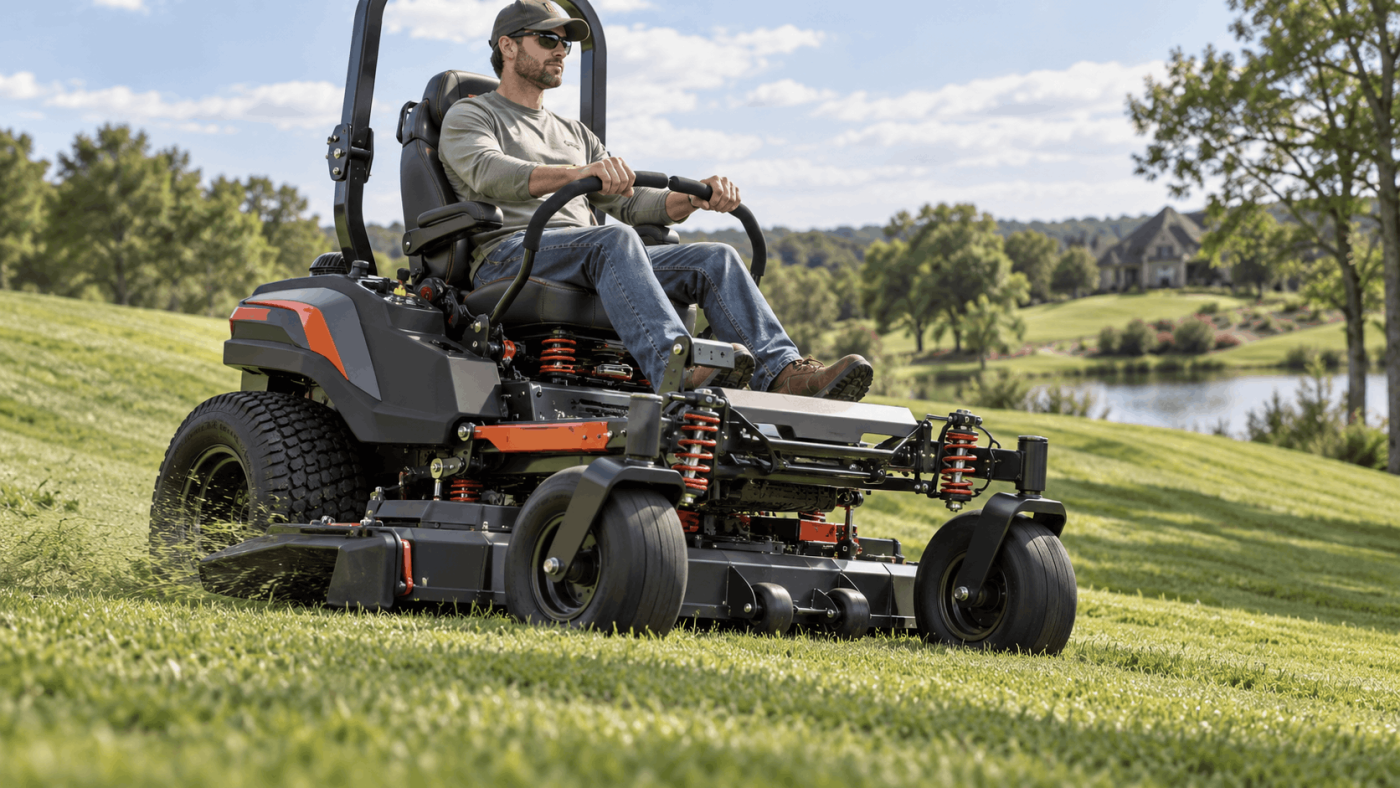
Two zero-turn mowers can both advertise suspension and still react to uneven ground in very different ways. One may move only the seat. Another adds movement at the front casters. A third integrates suspension into the mower chassis and coordinates it with the deck.
Before paying for an upgrade, ask one concrete question: which parts move relative to which other parts? The answer is more useful than the word “premium” on a seat label. This guide explains the hardware and a practical demonstration process; it does not rank machines by comfort we have personally measured.
Start with the problem you are trying to solve
Describe a normal mowing session before choosing a suspension system. Is the discomfort mainly from small repeated bumps, a seat that does not suit you, awkward lever reach, or a rough section that also leaves an uneven cut? Those observations help a dealer prepare a relevant demonstration.
Also separate roughness from slope. A level lawn can be bumpy, while a smooth bank can present a serious control problem. A comfort upgrade is not permission to exceed the operating limits in the mower's manual. Our guide to mowers and slopes covers that separate buying question.
Seat springs and isolation mounts
These place a cushioning or movement element between the seat assembly and the machine supporting it. The exact arrangement varies, so the label alone does not tell you its travel, adjustability or suitability for your weight.
For example, the Ariens ZENITH 60 documents isolation in its seat package. The 48-inch column of Bobcat's current ZT3500 specifications describes a spring-suspension seat. These are reasons to inspect the seat mounting; neither description establishes that the rear wheels are suspended relative to the frame.
A thicker cushion is another distinct feature. Padding can change how a seat feels when you sit down, but it does not identify the suspension mechanism underneath. Ask to see that mechanism with the machine safely parked and the dealer handling the demonstration.
A suspension seat moves the operator support
A dedicated suspension seat can provide a separate mechanism beneath or within the seating assembly, sometimes with adjustment for the operator. Look for the actual controls and their instructions rather than assuming every high-back seat offers the same adjustment.
The Hustler FasTrak SDX 54 illustrates why equipment lists matter. Its manufacturer page specifies an upgraded suspension seat, while Flex Forks appear among the accessories. A demonstration machine fitted with both is a different configuration from a quote that includes only the standard seat.
Consider your contact points during a permitted demonstration: seat, feet and hands. If only the seat moves relative to the chassis, your feet and the steering controls may still be connected to the rigid platform. That mechanical distinction is why two setups that feel similar while stationary can feel different in use. It is not a claim that a suspension seat is ineffective; it is a reason to assess more than the cushion.
Front suspension forks add another mechanism
A suspended caster fork acts at the front wheel assembly. It is a different component from a suspended seat and does not, by itself, establish rear-wheel suspension.
The Gravely Pro-Turn ZX 52 documents both front suspension forks and a suspended seat in its model sheet. Treat those as two pieces of equipment to compare. Ask how each is adjusted and maintained, and whether the quoted mower includes the same parts as the demonstrator.
This also prevents a common shopping error: crediting an entire product family with equipment that belongs to an option package. Write the fitted part or package on the quote, not just “suspension.”
Full mower suspension involves more of the machine
Systems described as full suspension introduce movement between wheel-supporting assemblies and the chassis, rather than relying solely on the seat. Their layouts differ, and the cutting deck has to be considered as part of the design.
Ferris describes its ForeFront system using front axles, control arms, coil-over shocks and an isolated deck arrangement. The ISX 800 in our catalog is a useful starting point for asking a dealer to demonstrate that type of hardware. Do not assume that every model carrying the same brand has an identical suspension layout.
A softer-feeling ride and a better finished lawn are separate observations. A seat can feel comfortable while the deck still responds poorly to a particular stretch of ground. Conversely, a mower might cut acceptably at a pace that is uncomfortable for the operator. Judge both during the demonstration instead of using one as proof of the other.
How to make a dealer demonstration useful
- Match the equipment. Record the exact model, seat, tires and optional forks or suspension kit. Compare that list with the written quote.
- Set up for the operator. Have the dealer explain approved seat and suspension adjustments. Confirm that controls remain easy to reach in the intended position.
- Use a representative, permitted area. A flat showroom floor is useful for checking fit, but it cannot reproduce normal mowing. Ask for a safe demonstration location that reflects ordinary conditions on your property.
- Compare at a comparable working pace. A much slower pass can feel smoother regardless of equipment. Do not turn the comparison into a maximum-speed test; use speeds appropriate to the manual, terrain and grass.
- Inspect the result separately. If a mowing demonstration is available, look at the finish as well as the ride. Note the grass conditions and settings rather than attributing every difference to suspension.
- Write down the trade-offs. Include adjustment, access for cleaning, maintenance requirements and the price of the exact demonstrated setup.
Do not change tire pressures outside the manufacturer's specification to make a test feel softer. Likewise, do not alter seat switches, mounts or restraint equipment to fit an unapproved replacement seat. Ask the manufacturer or dealer about compatibility before considering a retrofit.
When an upgrade is worth considering
For a small, fairly smooth lawn, a well-fitting seat and suitable controls may settle the comfort question. For frequent, longer sessions, a suspension seat or additional wheel suspension deserves a direct comparison. If roughness affects both operator comfort and the finish, include a machine with an integrated suspension and deck design in the demonstration.
The correct budget comparison includes the whole job. An upgrade that feels appealing for five minutes may matter little on a short route; equipment that makes repeated sessions more manageable can have a stronger case. Neither conclusion follows automatically from the highest specification or largest deck.
Before ordering, ask which suspension parts are standard, which have separate warranty terms, and what maintenance the manual requires. For example, our Bobcat ZT3500 48 review explains why even the seat description needs checking by deck configuration. The same attention to detail should apply to any shortlist.
Research note: Manufacturer descriptions checked October 6, 2026. The linked examples explain mechanisms and configurations; they are not results of a controlled ride, vibration or cutting test. Confirm the machine supplied in your region before purchase.