Will a Zero-Turn Mower Fit Through Your Gate? A Width Checklist
Deck size measures the cut, not the complete mower. Use actual machine dimensions, gate hardware and the approach to check fit before buying.
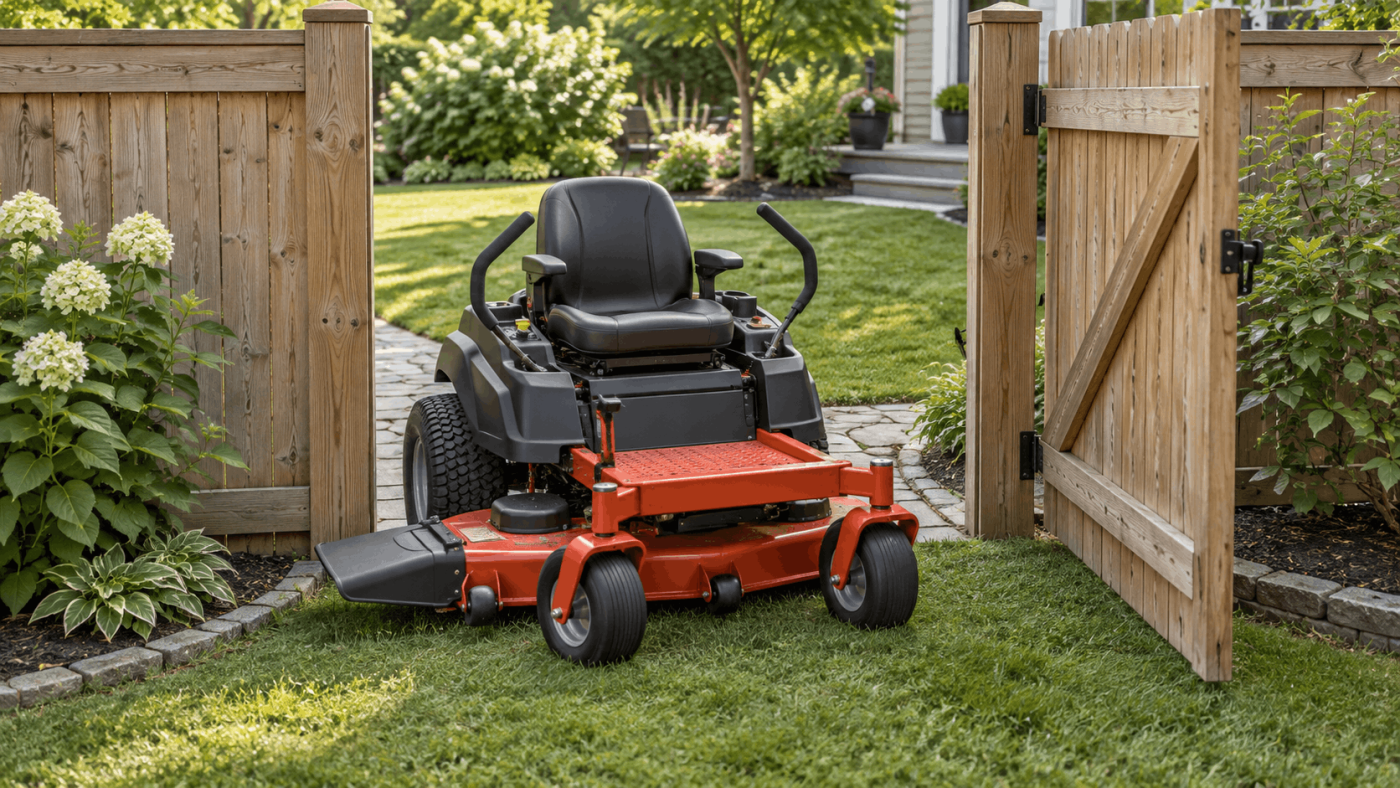
A mower can have the right engine, the right cutting width and a sensible price, then become the wrong purchase at the first gate. The number on the deck describes the swath it cuts. It does not tell you the width of the complete machine, its discharge chute or an attached grass catcher.
For a fenced yard, start with the narrowest opening on the route from storage to lawn. Then match it to a clearly defined measurement for the exact model you are buying. This guide focuses on that access check; our deck-size guide covers the separate question of cutting width and acreage.
Measure the opening you actually have
Open the gate to the position it can reliably reach, then measure the clear gap. Do not use the advertised size of the gate panel: posts, hinges, stops and latches may reduce the usable space. Check for anything protruding at the height of the mower's deck and body, not just at the top of the posts.
Record three things before visiting a dealer:
- The narrowest clear opening, including fixed hardware.
- The space available to approach in a straight line and leave the opening.
- Any other restriction on the route, such as a shed doorway, corner or passage beside the house.
A wide gate beside a sharp corner can be less convenient than it looks on paper. Take photographs and a simple sketch so the dealer understands the route. For dimensions that leave little room, ask for a fit demonstration or a written agreement about how fit will be established before delivery.
Learn what the width figure includes
Manufacturers do not always publish dimensions in the same configuration. Keep these descriptions separate:
- Cutting width: the nominal width of grass cut by the deck.
- Overall or assembled width: a complete-machine measurement whose included equipment needs checking.
- Chute-up or storage width: a measurement with a particular part repositioned; it is not automatically a mowing configuration.
- Tire-to-tire width: the span of the tires, which can exclude parts that project farther out.
If a listing simply says “width,” ask what was measured. A package dimension or shipping-crate width is also not a substitute for a usable machine-clearance figure.
Four examples that show why the wording matters
The following are documented examples, not a ranking of which mower fits the narrowest gate. The measurements describe different configurations and should not be compared as though all four were taken with the chute in the same position.
Ariens EDGE 34 Briggs: identify the exact model
For EDGE 34 Briggs model 915281, the Ariens specification sheet lists 44.8 inches with the chute down, despite a 34-inch cutting width. The same sheet separately identifies a chute-up dimension. Ask the dealer to verify both figures on the unit offered, especially when comparing machines from different years or markets.
The lesson is simple: “34-inch mower” is not a promise of access through a 36-inch opening. Model-specific dimensions take priority over a broad size recommendation.
Hustler Dash XD 34: even the narrower configuration needs room
Hustler publishes 37.5 inches with the chute up for the Dash XD 34. Its official specifications also give a smaller tire-to-tire figure. Use the machine dimension, not the tire span, when assessing an opening.
A 36-inch clear gap is narrower than that published chute-up width. Do not plan the purchase around squeezing through or removing required protection. A different mower or a properly planned access change is the more useful decision to explore.
Toro TimeCutter 34: assembled width is a separate specification
Toro lists 45 inches assembled width for TimeCutter model 77301, alongside its 34-inch deck. The product page does not describe that assembled figure as chute-up clearance. We therefore do not relabel it or invent a smaller number for a fit chart.
Ask the dealer for the exact permitted configuration and measure the machine. Accessory choices also deserve checking before comparing it with another 34-inch mower.
John Deere Z315E: calculate the remaining clearance
For the Z315E 42, John Deere lists 50.4 inches with the mower and 46.5 inches with the deflector raised for storage. A nominal 42-inch deck therefore does not fit a 42-inch clear gate.
Suppose your measured opening is exactly 48 inches and you are comparing it with the 46.5-inch storage figure. The difference is 1.5 inches in total, or only 0.75 inch per side if perfectly centred. That calculation describes space on paper; it does not certify a safe or practical route. Hardware, the approach and the actual machine still need checking.
Do not buy against a made-up clearance allowance
There is no single extra inch figure in this guide that makes every mower and gate combination workable. A straight paved entrance and an awkward turn beside a wall are different problems. The useful sequence is to measure, compare like-for-like dimensions, and verify the real route before accepting the mower.
Likewise, a storage-width specification is not an instruction to operate with guards raised or removed. Keep discharge protection in the configuration required by the operator manual. Carry out close measurements with the machine parked and shut down according to its instructions; ask the dealer to handle any demonstration of moving parts or configuration changes.
Include the equipment you will leave attached
A bagger, its chute or other fitted equipment can change the space the mower needs. Decide how you intend to collect or discharge clippings before settling the access question. Request measurements for that complete setup, not just the unaccessorized machine on a showroom card.
Also think about storage length and access around the parked mower. Getting through the shed door is only part of the task if you then cannot reach the items stored beside it. Write down the configuration the dealer measured so it can be compared with the machine delivered.
When a smaller mower is the better purchase
If most of your mowing lies behind one restricted opening, a mower that reaches the grass comfortably can be more useful than a wider one that requires a second machine for the backyard. If only a small patch is inaccessible, keeping a suitable walk-behind for that area may be worth comparing with the cost of changing access.
Do not turn access into the only buying criterion, though. A compact machine still has to suit the workload, operator and terrain. Review its own manual rather than assuming a narrow mower gains extra slope capability. Consider a commercial compact model separately if your workload is professional; the shared deck width does not make a residential machine equivalent.
Questions to put on the dealer quote
- What exact model number, engine and deck configuration is being supplied?
- What is its measured width with the required discharge protection in place?
- Is the alternative width figure for storage, transport or an approved operating configuration?
- What changes when the accessories on my quote are installed?
- How will we confirm that it clears my measured opening and approach before delivery?
Answer those questions before making the price comparison. A good deal on the wrong footprint creates a problem that extra horsepower cannot solve.
About this guide: Width figures were checked against the linked manufacturer documents on October 5, 2026. This is research and measurement-planning guidance, not a hands-on fit test. Specifications can change; confirm the exact unit offered in the US or Canada with its dealer and operator manual.