Electric vs Gas Zero-Turn Mowers: Which Fits Your Yard (2026)
The real question is not which is better, it is which fits your yard. Runtime, cost, maintenance and acreage compared, with models to look at for each.
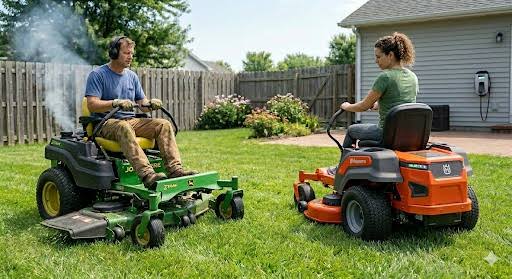
Ask whether electric or gas is better and you will get an argument. Ask which one fits your yard and you get a useful answer, because that is the real question. A battery zero-turn that is perfect for a flat suburban acre is the wrong machine for a hilly five-acre property, and a big gas mower is overkill for a lawn you could clear in forty minutes.
Here is where each type genuinely wins in 2026, the runtime maths that decides most purchases, and which machines to look at once you have picked a side.
Electric has actually caught up
It is worth saying plainly, because the old reputation lingers. Early battery mowers were weak and short-winded. That is no longer true at the riding level. Today's electric zero-turns run brushless motors with instant torque, and the better ones cut somewhere between 1.5 and 3 acres on a charge. The market has grown fast, from about $5.55 billion in 2025 to a projected $6.20 billion in 2026, and that money has gone into real improvements in battery capacity and cut quality.
What has not changed is physics. A tank of petrol still holds more usable energy than a battery pack you can fit under a mower seat, so gas keeps its lead on the one thing that matters most on big ground: how long you can mow before you stop.
Where electric wins
Maintenance almost disappears. No oil changes, no spark plugs, no air or fuel filters, no carburettor to gum up over winter. You sharpen the blades and keep the deck clean, and that is close to the whole list. Our maintenance guide covers everything a gas machine needs by comparison, and it is a long read for a reason.
Running costs are low. A full charge on a typical riding battery costs somewhere between 45 cents and about a dollar twenty, depending on your electricity rate. Set that against petrol plus the oil and parts a gas engine drinks over a season and the gap is real.
It is quiet and clean. Quiet enough to mow early without waking the street, with no exhaust in your face and no fuel to spill on the driveway. For some buyers that alone settles it.
Starting is effortless. Turn a key, press a pedal, go. No pull cord, no choke, no cranking a cold engine in spring.
Where gas still wins
Runtime is unlimited. When a gas mower runs low you pour in more fuel and keep going. When a battery runs low you wait hours to recharge, or you buy a second expensive pack. On anything over about two acres, this is the difference that matters.
Raw power in tough conditions. Tall, wet, thick grass pulls hard, and a big gas twin shrugs it off. Electric torque is strong, but sustained heavy load drains a battery fast.
Lower upfront price on bigger machines. For walk-behind mowers the prices have nearly converged. For riding and zero-turn mowers the gap is still wide, and a capable gas zero-turn often costs less to buy than an electric one with enough battery to match it.
Proven longevity. A well-maintained gas engine runs for many years, and everyone knows how to fix one. Battery packs are newer, and their long-term replacement cost is still an open question.
The maths that actually decides it
Forget the badge for a moment and do this sum instead.
Work out your real mowable area, which is your lot minus the house, the driveway and the beds. Then look honestly at how an electric machine's rated range lines up with it. Those "cuts up to X acres" figures assume open, even, dry grass, and hills eat into them hard, so expect 20 to 40 percent less range on sloped ground.
- Under 1.5 acres, mostly flat: electric is a genuinely good fit and often the nicer machine to own.
- 1.5 to 3 acres: electric can work, but buy the widest deck and the biggest battery bundle you can, or you will be recharging mid-job.
- Over 3 acres, or hilly, or thick grass: gas still makes more sense, because unlimited runtime beats everything else on ground that size.
If you take one thing from this article, take that. Size the runtime to your lawn before you fall in love with either type.
Cost over time, not just at the till
Electric costs more to buy and less to run. Gas costs less to buy and more to run. Where you land depends on how long you keep the machine and how much you mow.
The catch that people forget is the battery. Lithium packs typically last 3 to 5 years, or roughly 500 to 800 charge cycles, before they hold noticeably less. A replacement pack is a real expense, so factor one into a ten-year ownership plan for an electric mower. It can still come out ahead on running costs, but the sum is closer than the "no gas, no oil" pitch suggests.
Slopes, terrain and the fine print
Most electric zero-turns handle moderate slopes of 15 to 20 degrees, and the instant torque actually climbs low-speed hills well. Just remember the runtime penalty on that terrain. Above 15 degrees, any zero-turn gets risky, a point we make in our guide on how to choose a zero-turn, and a walk-behind is the safer tool.
Rules are shifting too. California now requires new lawn mowers sold in the state to meet zero-emission standards, and other states are watching. It has not made gas mowers disappear, but if you are in an affected area it is worth knowing before you buy.
Which electric zero-turn to look at
The category has a clear leader and some strong value picks. On the residential side, the EGO Z6 52 is the machine most buyers should start with, pairing a fabricated steel deck with a battery that clears up to four acres when fully bundled. The Ryobi 80V HP 54 adds an easy one-handed joystick and the reassurance of Home Depot's service network, while the Greenworks CrossoverZ 42 is the cheapest sensible way in and the Greenworks MaximusZ 54 steps up with more deck and a handy dump bed.
For professionals, electric now reaches genuinely commercial machines. The Greenworks OptimusZ 60 claims a 16-acre range and a 16 mph top speed, and the Mean Green Rival 60 uses an aluminium chassis to run up to seven hours a day. Both cost far more than a gas equivalent, so the sums only work if quiet, emission-free all-day mowing is worth real money to your business.
Which gas zero-turn to look at
If your ground rules out electric, gas gives you the full range of the market. For a first machine on a suburban lawn, something like the Cub Cadet ZT1 42 or a Toro TimeCutter 50 covers the basics affordably. Our ranked picks under $4,000 are all gas, and for real acreage you move up into the commercial machines that no battery can yet match on runtime. Browse the full catalogue in our reviews with specs and a ZT Score for each.
The bottom line
There is no universal winner, only a right answer for your yard. If you mow a flat lawn under a couple of acres and you value quiet, low-maintenance, plug-in simplicity, electric has arrived and you will probably enjoy it more. If you mow big, hilly, or heavy ground, or you just want to refuel and keep going, gas still wins and will for a while yet.
Work out your real mowable acreage, be honest about your slopes, and match the machine to the ground. Our mower finder does exactly that in a few questions if you would rather be pointed straight at the shortlist.